1Learning objectives
- Explain the mechanisms of local anaesthetic toxicity and of lipid emulsion therapy.
- Identify patients, blocks and techniques at higher risk, and plan a safe dose.
- Recognise early, severe, neurological and cardiovascular toxicity, including atypical and delayed presentations.
- Lead the immediate response: stop injection, call for help, airway, seizure control, lipid emulsion and circulatory support.
- Calculate lipid emulsion doses and know how the UK and ASRA regimens differ.
- Adapt advanced life support for LAST.
- Organise post-event care, and train the team with drills and simulation.
2Overview
In an emergency, use the LAST emergency protocol or the QRH card. This module is intended for education, not for use during a crisis.
Local anaesthetic systemic toxicity (LAST) results from plasma concentrations of local anaesthetic sufficient to produce central nervous system and cardiovascular toxicity. It is uncommon but can be fatal. Its epidemiology has changed with the evolution of fascial plane blocks and continuous infusions: presentation is now more often delayed, slower in onset and outside the operating theatre.
All clinicians who administer local anaesthetic, and those responsible for patients afterwards, should be able to recognise LAST and know the location of lipid emulsion.
Pharmacology
Local anaesthetics block voltage-gated sodium channels. In the brain, inhibitory pathways are blocked first, producing initial excitation (agitation, twitching, seizures) followed by depression (coma, apnoea). In the heart, sodium channel block slows conduction (broad QRS, bradycardia, block); potassium and calcium channel block and impaired mitochondrial energy production depress contraction.
Bupivacaine binds cardiac sodium channels quickly and releases them slowly ('fast in, slow out'), so it is more cardiotoxic than lidocaine. The S-enantiomers levobupivacaine and ropivacaine have a wider margin, but can still cause cardiac arrest.
Lipid emulsion is thought to act through several mechanisms: redistribution of local anaesthetic from the heart and brain to the liver and muscle (a 'scavenging shuttle'), a direct positive inotropic effect, and post-conditioning cardioprotection (Neal 2018).
| Drug | Relative cardiotoxicity | Note |
|---|---|---|
| Lidocaine | Lower | CNS signs usually come well before cardiac collapse |
| Prilocaine | Lower | Methaemoglobinaemia at higher doses |
| Ropivacaine | Intermediate | Less cardiotoxic than bupivacaine at equal doses |
| Levobupivacaine | Intermediate | S-enantiomer of bupivacaine |
| Bupivacaine | Highest | Collapse can be the first sign; resuscitation is prolonged |
3Incidence
Registry data report an incidence of approximately 0.3 to 0.9 per 1000 peripheral nerve blocks (Gitman 2018; Barrington 2013). Ultrasound guidance was associated with a reduced risk in the Australian and New Zealand registry (Barrington 2013), but does not eliminate it.
Presentation has shifted towards delayed onset after fascial plane blocks, continuous infusions and infiltration, in smaller and sarcopenic patients, and in settings outside the operating theatre (Neal 2018; Macfarlane 2021).
4Risk factors
| Group | Higher risk when |
|---|---|
| Patient | Extremes of age; low muscle mass (frail, sarcopenic, small adults); heart disease (low ejection fraction, ischaemia, conduction disease); liver disease; pregnancy; metabolic disorders (mitochondrial disease, carnitine deficiency) |
| Drug | Bupivacaine; large total dose; repeated doses; mixing two local anaesthetics (toxicity adds up); no adrenaline in a large dose |
| Site | Highly vascular sites (intercostal, caudal, epidural, neck); fascial plane blocks with large volumes; bilateral blocks |
| Technique | Continuous infusions and catheters; tumescent infiltration; blocks without ultrasound; the patient sedated or anaesthetised (early warning symptoms are hidden) |
| Setting | Outside theatre (wards, clinics, emergency departments) where lipid, monitoring and trained staff may not be ready |
The third ASRA advisory notes a trend towards delayed presentation, events after infusions and infiltration, small and sarcopenic patients, and more cases involving non-anaesthetists (Neal 2018).
Injection site and absorption
Peak plasma concentration depends on the vascularity of the injection site. A commonly quoted order, from highest to lowest, is: intravenous, intercostal, caudal and epidural, brachial plexus, sciatic and femoral, subcutaneous. Fascial plane blocks such as erector spinae, transversus abdominis and serratus anterior plane blocks deposit large volumes in vascular tissue planes, and peak concentrations may be delayed (30–60 minutes or longer).
- Direct intravascular injection (into an artery or vein near the target) produces toxicity within seconds. Injection into a vertebral or carotid artery can produce seizures with a very small dose.
- Systemic absorption from the injection site produces toxicity over minutes to an hour.
- Accumulation during continuous infusion produces toxicity over hours to days.
5Clinical recognition
LAST should be considered in any patient who has received local anaesthetic by any route within the preceding hours and develops confusion, drowsiness, agitation, seizures, arrhythmia or cardiovascular collapse. The classic progression from neurological to cardiovascular signs is frequently absent.
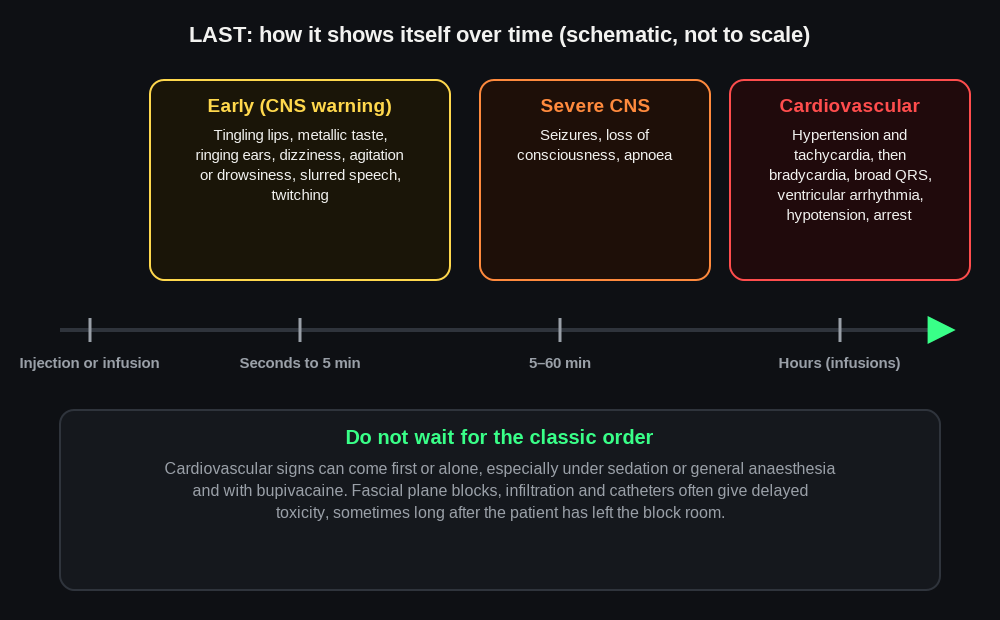
Clinical recognition timeline. The order and timing of signs vary, and cardiovascular signs may occur first.
Early symptoms
- Tingling or numbness round the mouth and tongue, metallic taste.
- Ringing in the ears, light-headedness, blurred vision.
- Agitation, anxiety, a sense of impending doom, or drowsiness and dysarthria.
- Muscle twitching.
These symptoms are easily missed under sedation or general anaesthesia, or on a busy ward. Ask the patient about symptoms during and after injection.
Neurological manifestations
Excitation then depression: agitation, confusion, twitching, generalised seizures, then reduced consciousness, coma and respiratory arrest. Seizures were the most common presenting feature in published cases and registries (Gitman 2018). Hypoxia and acidosis resulting from seizures potentiate cardiac toxicity, so seizures should be controlled promptly.
Cardiovascular manifestations
Early: hypertension and tachycardia (CNS excitation, or adrenaline in the solution). Later: bradycardia, conduction block, broad QRS, ventricular ectopics, ventricular tachycardia or fibrillation, hypotension and asystole. With bupivacaine, and under anaesthesia, cardiovascular collapse can be the first sign.
Severe toxicity
Sudden loss of consciousness, seizures or cardiovascular collapse. Lipid emulsion is indicated immediately, together with standard resuscitation. Recovery from LAST-related cardiac arrest may take more than an hour, so CPR should be continued.
6Treatment
Immediate management: emergency response pathway
- RecogniseChange in mental state, seizure, arrhythmia or collapse during or after local anaesthetic.
- Stop injectingStop the injection or infusion. Call for help and the lipid. Tell the team: 'I think this is local anaesthetic toxicity.'
- Airway and breathing100% oxygen, secure the airway if needed, avoid hypercarbia (mild hyperventilation helps). Confirm IV access.
- SeizuresSmall incremental doses of benzodiazepine. Thiopental or propofol with caution. Consider neuromuscular block if seizures continue.
- Lipid emulsion 20%Bolus 1.5 mL/kg over 2–3 min, then 15 mL/kg/h. Repeat bolus at 5 and 10 min if needed; double the infusion after 5 min; maximum 12 mL/kg.
Cardiac arrestCPR to standard protocols plus lipid. Adrenaline 1 microgram/kg or less, no vasopressin. Continue CPR for at least an hour if needed; consider cardiopulmonary bypass or ECMO.No arrestTreat hypotension, bradycardia and arrhythmias in the usual way; avoid further local anaesthetic, beta-blockers and calcium channel blockers.
- AfterwardsMonitored bed, check amylase or lipase, report, debrief, explain to the patient.
Pathway drawn from the Association of Anaesthetists QRH card 3-10 (v2, June 2023), with ASRA 2020 checklist advice on drugs to avoid. Full protocol: LAST emergency protocol.
Lipid emulsion therapy
Lipid emulsion should be given early, at the first signs of severe toxicity (seizures, cardiovascular instability or arrest), not only after cardiac arrest. UK and US guidance both use weight-based dosing; the regimens differ in detail.
| Association of Anaesthetists QRH (v2, June 2023) | ASRA checklist (2020 version) | |
|---|---|---|
| Bolus | 1.5 mL/kg over 2–3 min (about 100 mL for 70 kg) | Over 70 kg: 100 mL over 2–3 min. Under 70 kg: 1.5 mL/kg over 2–3 min |
| Infusion | 15 mL/kg/h | Over 70 kg: 200–250 mL over 15–20 min. Under 70 kg: about 0.25 mL/kg/min (ideal body weight) |
| If not improving | Repeat bolus at 5 and 10 min (maximum two more); double the infusion to 30 mL/kg/h after 5 min | Repeat bolus once or twice; double the infusion rate |
| Upper limit | 12 mL/kg in total | About 12 mL/kg |
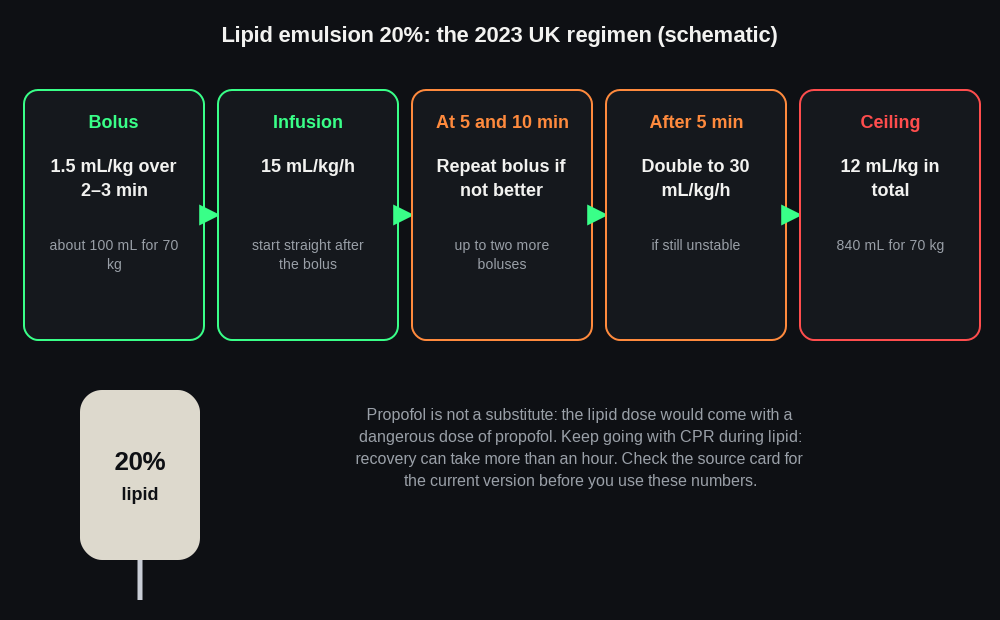
Lipid emulsion treatment, UK 2023 regimen. Check against the card in the LAST box.
Lipid dose by weight (exercise)
Enter a weight to see both regimens.
For learning only. In a real event use the card in your LAST box.
Note that 15 mL/kg/h is the same as 0.25 mL/kg/min. The main difference is the fixed adult dose above 70 kg in the ASRA checklist. Use the version stocked locally, and check the source card for updates.
Precautions and contraindications in treatment
- Propofol is not a substitute for lipid emulsion. Its lipid content is insufficient, and the required volume would cause myocardial depression.
- Adrenaline in cardiac arrest: use small doses (1 microgram/kg or less) rather than 1 mg.
- Avoid vasopressin, calcium channel blockers, beta-blockers and further local anaesthetic (for example lidocaine for arrhythmia) (ASRA 2020 checklist).
- Lipid limits: keep to the ceiling (about 12 mL/kg); very large doses can cause pancreatitis, lung injury and interfere with laboratory tests.
- Lipid emulsion has few contraindications in LAST; in a life-threatening event the benefit outweighs the risk.
Resuscitation considerations
- Standard advanced life support with high-quality CPR, plus lipid.
- Smaller adrenaline doses (1 microgram/kg or less): large doses can worsen arrhythmia and hinder lipid's effect.
- Avoid vasopressin, calcium channel blockers, beta-blockers and local anaesthetic anti-arrhythmics (ASRA 2020 checklist).
- Prolonged resuscitation: recovery may take more than an hour. Call early for cardiopulmonary bypass or ECMO where available.
- Pregnancy: left uterine displacement, and early decision on perimortem caesarean delivery as in any maternal arrest.
Post-event management
- Transfer to a monitored area (high dependency or intensive care) once stable. ASRA advises prolonged monitoring because toxicity can recur after lipid: at least 2 hours after a seizure, and 4–6 hours or more after cardiovascular instability (Neal 2018).
- Check amylase or lipase for pancreatitis after lipid; send blood for a local anaesthetic level if the laboratory offers it (take it before or soon after lipid, and note the lipid may interfere with some tests).
- Do not restart the infusion; decide on further surgery and analgesia as a team.
- Tell the patient what happened, apologise where appropriate, and document fully (duty of candour).
- Report locally and to national schemes, and to the lipid registry (lipidrescue.org) if lipid was used.
- Debrief the team and replace the lipid.
7Prevention
- Use the lowest effective dose and volume; prefer ropivacaine or levobupivacaine for large doses.
- Ultrasound guidance, with the needle tip and spread seen before every increment.
- Aspirate before each injection, and inject in increments of 3–5 mL with a pause between them; a negative aspirate does not exclude intravascular injection.
- Consider a vascular marker (adrenaline 2.5–5 micrograms/mL) for large doses where it is not contraindicated: a rise in heart rate or blood pressure suggests intravascular injection.
- Monitor ECG, blood pressure and oxygen saturation during and for at least 30 minutes after a large-volume block, and maintain verbal contact with the patient.
- Lipid emulsion and the protocol should be immediately available wherever blocks are performed and infusions run, including wards and day units.
- Communicate the administered dose to the surgical team, so that infiltration and wound catheters are included in the cumulative total.
Using ultrasound to reduce intravascular injection
- Pre-scan with colour Doppler to identify vessels in and near the needle path; small arteries cross many block sites (for example the dorsal scapular and transverse cervical arteries).
- Confirm the needle tip position before every injection.
- Inject in small increments (3–5 mL) and observe the spread each time. Absence of visible spread on injection indicates possible intravascular injection: stop, aspirate and relocate the needle tip.
- Veins close to the target are compressed by probe pressure and may be entered unrecognised. Release probe pressure before injecting.
Dose considerations
Published maximum doses are guidance rather than absolute thresholds: they are not derived from clinical trials and depend on the injection site, patient factors and the use of adrenaline (Rosenberg 2004). Toxicity may occur below them (intravascular injection, frail patients), and higher doses may be tolerated where absorption is slow.
- Calculate per kilogram, using lean or ideal body weight in obesity, and reduce for the frail, elderly, pregnant and those with heart or liver disease.
- Calculate the cumulative dose from all sources and all clinicians: block, top-up, catheter, wound infiltration, topical application and intravenous lidocaine.
- The toxicity of two local anaesthetics is additive: half the maximum dose of one plus half the maximum dose of the other reaches the limit.
- During infusions, plasma concentrations rise over several days; the hourly doses of all catheters should be summed.
Use the dose calculator (including 'Mix two drugs') and the paediatric calculator.
The LAST box
- Lipid emulsion 20% (at least 1000 mL in the area), with giving sets and large syringes (50 mL) for the bolus.
- The current QRH card or ASRA checklist, a weight-based dosing chart, and a record sheet.
- Benzodiazepine for seizures; airway equipment; resuscitation trolley and defibrillator.
- Contact details for cardiopulmonary bypass or ECMO if available locally.
- A label on the box with its check date; check it with the resuscitation trolley.
Team training
- Staff in every area where local anaesthetic is used should know the location of the LAST box and who is responsible for bringing it.
- Short in-situ drills (10 minutes) in the block room, theatre, recovery and wards are more realistic than classroom teaching.
- Practise roles: leader, airway, drugs and lipid, CPR, scribe and timekeeper (lipid timing matters).
- Include ward nurses and surgeons who perform infiltration or manage catheters, as many events now occur outside the operating theatre.
Simulation
The ASRA checklist was revised after simulation studies showed where teams went wrong (Neal 2021). Use scenarios that test recognition as well as treatment:
- Delayed onset: a confused patient on the ward 40 minutes after a bilateral erector spinae block.
- Atypical: bradycardia and broad QRS under general anaesthesia, no CNS signs.
- Infusion: tinnitus and drowsiness on day 2 of a femoral catheter in a frail patient.
- Arrest: ventricular fibrillation after an interscalene injection; practise lipid with CPR and small adrenaline doses.
Try the suspected LAST case in the Clinical Challenge.
8Evidence and limitations
Evidence on LAST derives from animal studies, case reports, registries and expert consensus. Randomised trials of lipid emulsion in humans have not been performed and are unlikely to be feasible. Recommendations are therefore graded as consensus. The main evidence:
| Source | Design | Main finding | Limitation |
|---|---|---|---|
| Barrington 2013 | Registry, 20 hospitals, 25 336 peripheral nerve blocks | LAST 0.87 per 1000; ultrasound associated with lower risk | Observational: association, not proof |
| Gitman 2018 | Review of case reports 2014–16 and registries | Registry incidence 0.27 per 1000 blocks; seizures most common | Case reports are selected and incomplete |
| Neal 2018 (ASRA advisory) | Expert consensus with literature review | Delayed presentations, sarcopenia, non-anaesthetist settings; lipid mechanisms | Consensus-level evidence |
| Macfarlane 2021 | Narrative review | Rising share of cases after fascial plane blocks; at-risk groups | Narrative, not systematic |
Statistical versus clinical significance: the reduced relative risk with ultrasound is clinically important because of the severity of LAST; the absolute risk reduction is small, and events can still occur with optimal technique.
9Clinical cases
WORKED CASEBilateral erector spinae, 40 minutes later
A frail 55 kg 80-year-old had bilateral erector spinae blocks with 40 mL of 0.375% levobupivacaine for rib fractures. Forty minutes later, back on the ward, they are confused and complain of ringing in the ears. Heart rate 52, broad QRS on the monitor.
Discussion. This is LAST until proven otherwise: 150 mg is above the usual guide of 2.5 mg/kg (about 140 mg for 55 kg) in a frail patient, absorption from a plane block peaks late, and there are CNS and cardiac signs. Stop any infusion, call for help and the lipid, oxygen and monitoring, and give lipid 20% 1.5 mL/kg (about 80 mL) over 2–3 min, then 15 mL/kg/h (about 13.75 mL/min). Move to a monitored area.
10References
- Association of Anaesthetists. Quick Reference Handbook 3-10: Local anaesthetic toxicity (version 2, June 2023). CC BY-NC-SA 4.0. Source
- Neal JM, Neal EJ, Weinberg GL. American Society of Regional Anesthesia and Pain Medicine Local Anesthetic Systemic Toxicity checklist: 2020 version. Reg Anesth Pain Med 2021;46:81–82. PubMed 33148630
- Neal JM, Barrington MJ, Fettiplace MR, et al. The third American Society of Regional Anesthesia and Pain Medicine practice advisory on local anesthetic systemic toxicity: executive summary 2017. Reg Anesth Pain Med 2018;43:113–123. PubMed 29356773
- Macfarlane AJR, Gitman M, Bornstein KJ, El-Boghdadly K, Weinberg G. Updates in our understanding of local anaesthetic systemic toxicity: a narrative review. Anaesthesia 2021;76 Suppl 1:27–39. PubMed 33426662
- Barrington MJ, Kluger R. Ultrasound guidance reduces the risk of local anesthetic systemic toxicity following peripheral nerve blockade. Reg Anesth Pain Med 2013;38:289–299. PubMed 23788067
- Gitman M, Barrington MJ. Local anesthetic systemic toxicity: a review of recent case reports and registries. Reg Anesth Pain Med 2018;43:124–130. PubMed 29303925
- El-Boghdadly K, Pawa A, Chin KJ. Local anesthetic systemic toxicity: current perspectives. Local Reg Anesth 2018;11:35–44. PubMed 30122981
- Rosenberg PH, Veering BT, Urmey WF. Maximum recommended doses of local anesthetics: a multifactorial concept. Reg Anesth Pain Med 2004;29:564–575. PubMed 15635516
Every reference checked on PubMed (or at the publisher for guidance not indexed there) on 15 November 2026.