Level of difficulty
Advanced. The landmarks (coracoid, humeral head and subscapularis) are part of a standard shoulder scan, but the needle must pass through subscapularis to reach the capsule, and the evidence base is still small.
Anatomy
The front of the shoulder joint is covered by the anterior capsule and the glenohumeral ligaments, with the tendon of subscapularis directly in front of them. Deltoid lies over subscapularis, separated by a fascial plane, with coracobrachialis and the short head of biceps arising from the coracoid more medially.
The anterior capsule is supplied by articular branches of the axillary nerve, the upper and lower subscapular nerves, the lateral pectoral nerve and sometimes the musculocutaneous nerve. The suprascapular nerve supplies most of the top and back of the joint.
The SHAC block uses two spaces: the interfascial plane between the deep layer of the deltoid fascia and the superficial layer of the subscapularis fascia, and the pericapsular space deep to subscapularis. Local anaesthetic in the pericapsular space can also enter the joint through the foramen of Weitbrecht, a natural gap between the superior and middle glenohumeral ligaments.
Surface anatomy
- Coracoid process.
- Humeral head and lesser tuberosity.
- The probe lies over the front of the shoulder, lateral to the coracoid.
Indications
- Arthroscopic shoulder surgery and rotator cuff repair, with a suprascapular nerve block, as a phrenic-sparing alternative to interscalene block.
- Chronic shoulder pain (frozen shoulder, arthritis, cuff disease) to allow physiotherapy.
- Shoulder dislocation and proximal humeral fractures in the emergency department (case series).
Nerves blocked
- Articular branches of the axillary nerve and the upper and lower subscapular nerves.
- Articular branches of the lateral pectoral nerve and, in some patients, the musculocutaneous nerve.
- Not blocked: the suprascapular nerve and the skin over the shoulder. Add a suprascapular nerve block for surgery.
Landmark technique
Surface anatomy, relevant structures and landmarks
No landmark technique. The block depends on ultrasound.
Positioning
Not applicable.
Block technique
Use ultrasound.
Needle choice
Not applicable.
Neurostimulation technique
Not used.
Choice of local anaesthetic (including volume)
Same as for the ultrasound technique.
Ultrasound technique
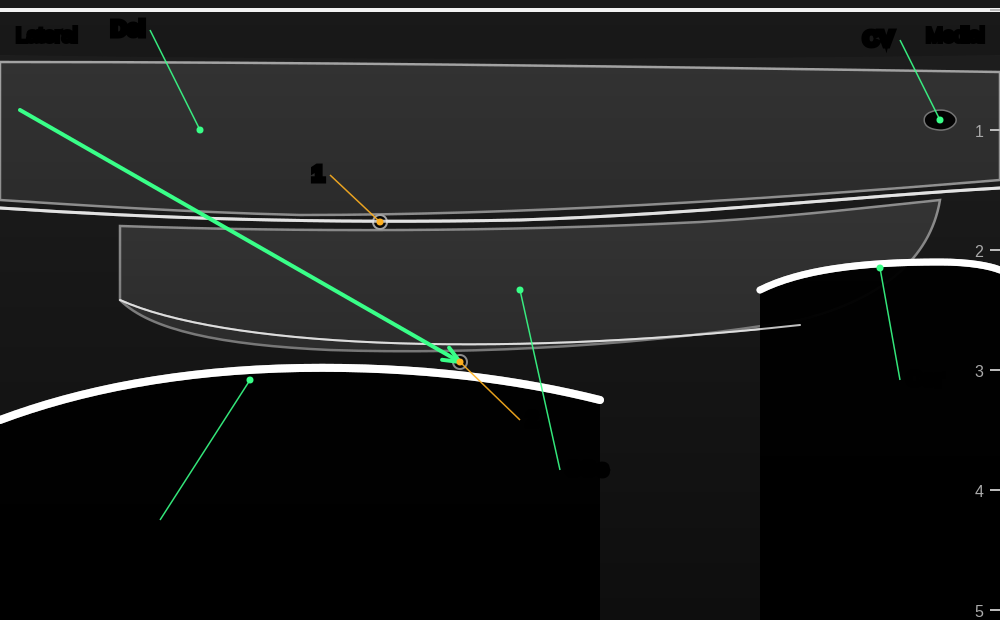
Linear probe over the front of the shoulder, lateral to the coracoid, arm externally rotated. The needle first stops in the plane under deltoid (1), then passes through subscapularis to the bright capsule on the humeral head (2).
- Del
- deltoid
- SSc
- subscapularis, myotendinous junction (dotted appearance)
- HH
- humeral head with the anterior capsule on it
- Cor
- coracoid process
- CV
- cephalic vein
- 1
- first injection: between the deep deltoid fascia and the superficial subscapularis fascia
- 2
- second injection: through subscapularis, onto the anterior capsule (pericapsular)
Positioning
Beach chair or supine. In the original description the arm is extended so that subscapularis is stretched backwards, then externally rotated and slightly abducted to move coracobrachialis and biceps out of the way.
Scanning technique
- Place a linear probe over the front of the shoulder, lateral to the coracoid.
- Find the humeral head and the coracoid, with subscapularis between them, deep to deltoid.
- The myotendinous junction of subscapularis has a mixed, dotted appearance that helps to recognise it.
- Identify the bright line of the anterior capsule on the humeral head deep to subscapularis, and check for vessels with colour Doppler.
Structures to identify
- Deltoid
- Subscapularis and its myotendinous junction
- Coracoid process
- Humeral head and anterior capsule
- Coracobrachialis and short head of biceps
- Cephalic vein and circumflex humeral vessels
Block performance
Position / ergonomics
Stand at the side or head of the bed, with the screen in your line of sight.
Probe
High-frequency linear probe.
Settings
Musculoskeletal preset, depth 3–5 cm.
Depth
2–4 cm to the capsule.
Needle size
22 G, 50–80 mm short-bevel block needle.
Needling technique
In-plane. First place the tip in the plane between deltoid and subscapularis and inject part of the volume. Then advance through subscapularis until the tip lies on the anterior capsule and inject the rest.
Optimal needle-tip position
Injection 1: between the deep deltoid fascia and the superficial subscapularis fascia, in front of the myotendinous junction. Injection 2: in the pericapsular space deep to subscapularis, on the humeral head or anterior glenoid rim.
Drug choice
The first clinical series used 0.2% ropivacaine with dexamethasone 8 mg for chronic shoulder pain. For surgery, 0.375–0.5% ropivacaine or 0.25–0.5% levobupivacaine is reasonable.
Volume
10–15 mL in total in the original description, divided between the two injections.
Optimal current if nerve stimulation is used
Not applicable.
Muscle responses acceptable
Not applicable.
Testing block success
Pain relief on passive movement of the shoulder, with normal grip, elbow flexion and breathing.
Continuous techniques
Indication
Not described. Single injection only at present; the block can be repeated for chronic pain.
Kit
Not applicable.
Catheter
Not applicable.
Regime
Not applicable.
Contraindications to the block
Absolute
- Patient refusal
- Infection at the injection site or in the joint
- Allergy to local anaesthetic
Relative
- Anticoagulation (follow guidance for intermediate-depth blocks)
- Joint replacement or implant at the injection site (intra-articular spread)
- Distorted anatomy after previous surgery
Side effects and complications
Side effects
- Incomplete analgesia if used without a suprascapular nerve block
- Intra-articular spread, which may be wanted for analgesia but matters with implants
Complications
- Vascular puncture (cephalic vein, circumflex humeral vessels)
- Joint infection (strict asepsis, because the needle reaches the capsule)
- Local anaesthetic toxicity
Pearls of wisdom
- Extension and external rotation of the arm stretch subscapularis and open the plane under deltoid.
- The dotted myotendinous junction of subscapularis is the key landmark.
- Inject in two steps: first the deltoid–subscapularis plane, then on the capsule.
- Combine with a suprascapular nerve block for shoulder surgery, because the SHAC does not cover the top and back of the joint.
- Because there is no phrenic nerve block, it is attractive for patients with poor lung function and in the emergency department.
Review of literature
- Galluccio and colleagues (2021) described the SHAC block and reported 75 patients with chronic shoulder pain treated with SHAC alone or with a suprascapular nerve or PECS II block. Pain fell by about 6 points out of 10, all patients completed physiotherapy straight away, and there was no motor block or adverse event.
- Caliskan and colleagues (2024) randomised 40 patients having arthroscopic rotator cuff repair to SHAC or interscalene block. Pain scores over 48 hours and analgesic use were similar.
- Shakeri (2024) questioned the methods of that trial, and the authors replied; the debate is worth reading before relying on the result.
- Makowski and colleagues (2026) and Fernandes and colleagues (2026) reported small emergency department series of SHAC blocks for shoulder dislocation and proximal humeral fracture. Some patients had reduction without sedation; results were variable.
- Evidence is limited to one small randomised trial and case series.
Comparison with other blocks
| Block | Target | Phrenic nerve | Notes |
|---|---|---|---|
| Interscalene | C5–C7 roots | Almost always blocked | Most evidence; dense analgesia |
| Suprascapular + axillary | Two nerves | Spared | Two injection sites |
| Subscapularis plane | Subscapular and axillary nerves | Spared | Single plane injection |
| SHAC | Deltoid–subscapularis plane plus anterior capsule | Spared | Two-step injection; add suprascapular block for surgery |
References
- Galluccio F, Fajardo Perez M, Yamak Altinpulluk E, Hou JD, Lin JA. Evaluation of interfascial plane and pericapsular nerve blocks to the shoulder joint: a preliminary analysis of shoulder anterior capsular block. Pain Ther 2021;10:1741–1754. PubMed
- Caliskan B, Ataoglu C, Ok M, Yamak Altinpulluk E. Comparison of shoulder anterior capsular block and interscalene brachial plexus block for shoulder arthroscopy: a preliminary analysis. Minerva Anestesiol 2024;90:22–30. PubMed
- Shakeri A. Comment on: Comparison of shoulder anterior capsular block and interscalene brachial plexus block for shoulder arthroscopy: a preliminary analysis. Minerva Anestesiol 2024;90:832–833. PubMed
- Caliskan B, Altinpulluk EY. Comparison of shoulder anterior capsular block and interscalene brachial plexus blocks: reply to Dr. Shakeri. Minerva Anestesiol 2024;90:833–834. PubMed
- Makowski B, Riwniak C, Ritz A, Simon E, Stenberg R. Rethinking shoulder analgesia: the SHAC block technique and utilization in the emergency department. Am J Emerg Med 2026;110:278–281. PubMed
- Fernandes C, Muzaurieta A, Cassianni C, et al. Shoulder anterior capsular (SHAC) block for analgesia in anterior shoulder dislocation: an emergency department case series. Am J Emerg Med 2026;110:584–588. PubMed
Test yourself: Shoulder anterior capsule block (SHAC block)
4 questions on this page and up to 4 on the picture: name the structure at the numbered dot. Score 70% or more to add this topic to My learning and your certificate. You can try again as often as you like.
New to ultrasound? Start with the Basics of ultrasound or try the scan explorer. Compare this block with another. Patient discussion sheet. Add to my logbook.