1Learning objectives
- Distinguish acute, subacute and chronic pain, and define chronic postsurgical pain.
- Describe the mechanisms that turn acute pain into chronic pain, including peripheral and central sensitisation.
- Explain the uses and pitfalls of diagnostic blocks.
- List common ultrasound-guided peripheral nerve interventions and the strength of evidence for each.
- Outline first-line drug treatment of neuropathic pain.
- Identify patients at risk of persistent postoperative pain and plan perioperative strategies that may reduce it.
2Overview
Most anaesthetists meet chronic pain in two ways: patients who already have it when they come for surgery, and patients who develop it after surgery. Regional techniques have a place in both, but a modest one. A block can help confirm where pain comes from, give a window of relief for rehabilitation, and may reduce the chance of persistent pain after some operations. It rarely cures chronic pain on its own.
This module explains how chronic pain differs from acute pain, where diagnostic and therapeutic blocks fit, and how to think about the evidence. It is not a substitute for training in pain medicine: interventions for chronic pain belong in a multidisciplinary plan.
Clinical pearls
- Chronic pain is a condition in its own right, not just acute pain that lasted too long.
- A positive diagnostic block shows that the area blocked is involved; it does not prove that a destructive procedure will help.
- Severe acute pain after surgery is one of the strongest predictors of pain that persists. Good acute analgesia matters.
3Mechanisms of chronic pain
Acute versus chronic pain
| Acute pain | Chronic pain | |
|---|---|---|
| Time | Expected course of injury or surgery | Persists or recurs for more than 3 months |
| Purpose | Protective: warns of tissue damage | No protective function; often outlasts healing |
| Mechanism | Nociception, with inflammation | Nociceptive, neuropathic or nociplastic; peripheral and central sensitisation |
| Treatment aim | Relief, recovery, function | Function and quality of life; complete relief is uncommon |
| Role of blocks | Main tool for surgical and trauma pain | Diagnosis, short-term relief to allow rehabilitation, selected long-term interventions |
The ICD-11 classification separates chronic primary pain (a condition in its own right, such as fibromyalgia or non-specific low back pain) from chronic secondary pain, which includes chronic postsurgical and post-traumatic pain.
How acute pain becomes chronic
- Peripheral sensitisation: inflammation lowers the threshold of nociceptors at the injury.
- Central sensitisation: repeated input increases the response of dorsal horn neurons, so normal touch can hurt (allodynia) and pain spreads beyond the injured area.
- Nerve injury: cut or stretched nerves (intercostal nerves at thoracotomy, intercostobrachial at axillary clearance, ilioinguinal at hernia repair) can generate ectopic activity and neuropathic pain.
- Psychological and social factors: anxiety, catastrophising, low mood and poor sleep amplify pain and predict persistence.
Blocking nociceptive input during and after surgery is one reason regional anaesthesia might reduce chronic pain, although the clinical evidence is mixed.
4Persistent postsurgical pain
Postoperative persistent pain
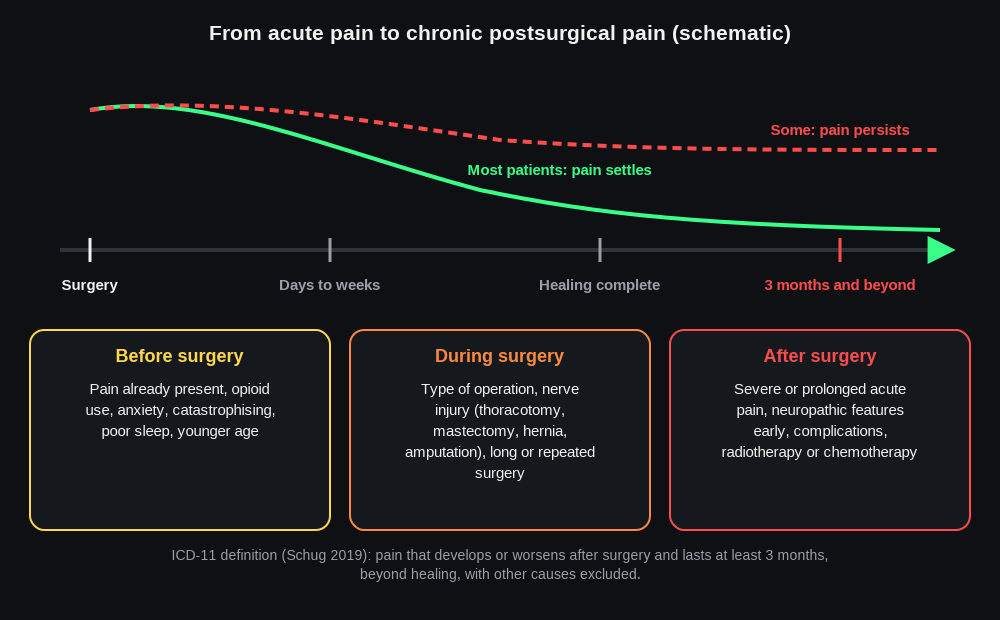
Persistent pain after surgery is common: 10–50% after operations such as groin hernia repair, breast and thoracic surgery, amputation and coronary bypass, and severe in 2–10% (Kehlet 2006). ICD-11 defines chronic postsurgical pain as pain that develops or increases after surgery and lasts at least 3 months, beyond healing, with other causes excluded (Schug 2019).
- Before surgeryAsk about existing pain, opioid use, anxiety and low mood. Optimise, set expectations, and plan analgesia.
- During surgeryNerve-sparing surgery where possible. Regional anaesthesia for high-risk operations (thoracotomy, breast, caesarean section).
- After surgeryTreat severe acute pain promptly. Look for early neuropathic features (burning, allodynia) and treat them.
- At follow-upAsk about pain at 6 weeks and 3 months. Refer early to the pain service if pain persists.
5Neuropathic pain
Neuropathic pain comes from a lesion or disease of the somatosensory nervous system: burning, shooting or electric pain, numbness with pain, and allodynia in a nerve's territory. Drugs are the first line, and the NeuPSIG review (Finnerup 2015) graded them:
| Line | Drugs | Comment |
|---|---|---|
| First | Tricyclic antidepressants, SNRIs (duloxetine), pregabalin, gabapentin | Modest effect: 6–8 patients treated for one to get 50% relief with SNRIs, pregabalin or gabapentin; fewer with tricyclics |
| Second | Lidocaine patches, high-concentration capsaicin patches, tramadol | Topical options for localised peripheral neuropathic pain |
| Third | Strong opioids, botulinum toxin A | Specialist use |
Nerve blocks can help localised neuropathic pain (for example a neuroma or entrapment) and confirm the nerve involved, but they are an addition to drug and physical therapy, not a replacement.
6Patient selection
Indications
- Clarifying the source of pain when it would change management (diagnostic block).
- A window of relief to allow physiotherapy and rehabilitation.
- Selecting patients for radiofrequency ablation or surgery.
- Palliative care: pain not controlled by drugs, or drugs not tolerated.
- Preventing persistent pain after surgery in high-risk operations (thoracotomy, breast surgery, caesarean section, amputation).
Patient selection: assess the whole person (physical, psychological and social). Repeated blocks without a plan to improve function rarely help.
Contraindications
- Patient refusal, or unrealistic expectations that have not been discussed.
- Local or systemic infection; anticoagulation for deep or non-compressible targets.
- Uncontrolled psychological distress, where an intervention may reinforce a cycle of procedures.
- Precautions: steroid use in diabetes (raises glucose for days); repeated steroid injections; radiofrequency near motor nerves.
7Diagnostic blocks and interventions
Diagnostic blocks
A diagnostic block asks a question: does numbing this nerve or structure relieve this pain? To answer it well:
- False positives: placebo response, spread to nearby nerves, systemic absorption, sedation.
- False negatives: missed target, pain from a more central source (central sensitisation), anxiety about the procedure.
- Define the clinical question and the outcome measure (pain score and a normally painful activity) before the procedure.
- Use a small volume so the drug stays on the target. A large volume spreads to other structures and gives a false positive.
- Avoid sedation and systemic opioids, which relieve pain whatever the block does.
- Record pain at set times, matched to the expected duration of the drug.
- Consider comparative blocks (a short-acting and a long-acting drug on different days) when the result decides a destructive or expensive treatment.
Peripheral nerve interventions
| Problem | Intervention | Notes |
|---|---|---|
| Knee osteoarthritis pain | Genicular nerve block; radiofrequency ablation after a positive block | Evidence is growing but mostly short-to-medium term; patient selection matters |
| Chronic shoulder pain | Suprascapular nerve block (± radiofrequency) | Posterior approach generally used for chronic pain interventions, to avoid the brachial plexus; often combined with physiotherapy |
| Meralgia paraesthetica | Lateral femoral cutaneous nerve block | Diagnostic and sometimes therapeutic, with or without steroid |
| Abdominal wall pain (anterior cutaneous nerve entrapment) | Rectus sheath block or trigger point injection | Pain at a small spot on the lateral edge of rectus; worse when tensing the abdomen |
| Post-herniorrhaphy groin pain | Ilioinguinal, iliohypogastric or genitofemoral block | Diagnostic; definitive options include neurectomy |
| Pudendal neuralgia | Pudendal nerve block | Diagnostic and therapeutic; part of a pelvic pain service |
| Post-mastectomy pain | Serratus anterior, intercostobrachial or ESP block | Short-term relief; evidence limited |
| Post-thoracotomy pain | Intercostal, ESP or paravertebral block | Short-term relief; consider neuropathic drugs |
Most use the same technique as described on the block pages. Steroid added to a block may lengthen relief in some conditions, but evidence is inconsistent and it should be used within a pain service.
Ultrasound-guided interventions
Ultrasound has made many pain procedures possible without radiation: peripheral nerve blocks, joint and bursal injections, trigger point injection, and some spinal procedures. It shows vessels and soft tissue that fluoroscopy cannot, and allows the spread to be observed in real time. Its limits are bony detail and depth: for facet joints and radiofrequency lesioning, fluoroscopy or CT is still often preferred.
Sonoanatomy
Chronic pain interventions use the same sonoanatomy as surgical blocks, often with smaller volumes and more distal targets, so the nerve must be seen clearly and traced. Points to note:
- Scar tissue and previous surgery distort planes: scan the other side for comparison.
- Small sensory nerves (genicular, lateral femoral cutaneous, anterior cutaneous branches) are often too small to see: use bony landmarks and vessels as guides.
- Neuromas may be visible as a bulbous swelling at the end of a cut nerve; reproducing the pain with gentle probe pressure supports the diagnosis.
- For radiofrequency procedures, fluoroscopy may still be used to confirm the position, depending on local practice.
 Ultrasound
 Illustration
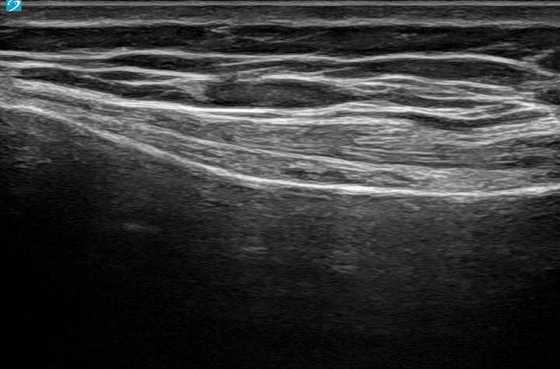
Genicular nerve block: targets near the bone where the genicular nerves run with their vessels. Genicular nerve block
 Ultrasound
 Illustration
Suprascapular nerve block: the image shows the anterior approach. For chronic pain interventions the posterior suprascapular approach is generally used, which keeps the needle away from the brachial plexus. Suprascapular nerve block
Equipment
- Linear and curvilinear probes; 22–25 G needles; short-acting and long-acting local anaesthetics.
- A pain diary or score sheet for diagnostic blocks.
- Radiofrequency generator and cannulae where used (specialist services).
- Resuscitation equipment and lipid emulsion, as for any block.
Drugs and volumes
Diagnostic blocks use small volumes, often 1–5 mL, so toxicity is rarely an issue, but drug choice matters: lidocaine for a short test, bupivacaine or levobupivacaine for a longer one. Steroids (for example dexamethasone, methylprednisolone or triamcinolone) are added in some chronic pain procedures; particulate steroids should not be injected near arteries (risk of embolic injury), so non-particulate dexamethasone is preferred where vessels are close. Follow the local pain service protocol.
8Complications and troubleshooting
Complications
- The same as for surgical blocks: vascular puncture, LAST, nerve injury, infection.
- Steroid effects: raised blood glucose, flushing, insomnia, skin atrophy or depigmentation at superficial sites.
- Radiofrequency: neuritis, skin burns, motor weakness if a motor nerve is lesioned.
- Psychological: false hope and dependence on repeated procedures.
Troubleshooting
- Block works for hours but pain returns: expected. The diagnostic block answered the question; the next step is a management plan.
- Block gives no relief despite a good spread: consider a more central or different source, or nociplastic pain.
- Relief lasts much longer than the drug: common and not fully explained (placebo, breaking a cycle of pain and muscle spasm, rehabilitation). Use the window for physiotherapy.
- New numbness or weakness after the drug should have worn off: assess and refer as for any nerve injury.
9Multimodal treatment
- Physical: graded activity and physiotherapy, the core of most chronic pain care.
- Psychological: pain education, cognitive behavioural approaches, acceptance and commitment therapy.
- Drugs: chosen for the type of pain; avoid long-term opioids for chronic non-cancer pain where possible, and plan opioid reduction after surgery.
- Interventions: blocks, radiofrequency and neuromodulation within the plan, not instead of it.
- Social: work, sleep, family and finances all affect pain.
10Evidence and limitations
Evidence and limitations
The Cochrane review update (Levene 2019) pooled 39 trials (3027 patients). Regional anaesthesia reduced persistent pain after thoracotomy (odds ratio 0.52, moderate quality), breast cancer surgery (0.43, low quality) and caesarean section (0.46, moderate quality). Continuous local anaesthetic infusion after breast surgery also helped. The authors warned that small trials, attrition and bias weaken the conclusions, and that the results cannot be extended to other operations or to children.
For chronic pain interventions, many trials are small, short and difficult to blind, and placebo responses are large. Neuropathic pain drugs have modest effects, and published trials overstate them by about 10% (Finnerup 2015).
Statistical versus clinical significance: ask how many patients had meaningful relief (for example 30–50%) and for how long, not only the mean difference in pain score.
11Clinical cases
WORKED CASEGroin pain a year after hernia repair
A 42-year-old has burning pain in the right groin and upper scrotum since a mesh hernia repair 14 months ago. Light touch hurts over a small area. Paracetamol and ibuprofen do not help.
Discussion. This is chronic postsurgical pain with neuropathic features (ilioinguinal or genitofemoral territory). A diagnostic ultrasound-guided ilioinguinal/iliohypogastric block with a small volume, with pain recorded before and after, can identify the nerve. Start a first-line neuropathic drug, involve the pain service and the surgeon, and discuss options if the block is positive.
12References
- Kehlet H, Jensen TS, Woolf CJ. Persistent postsurgical pain: risk factors and prevention. Lancet 2006;367:1618–1625. PubMed 16698416
- Schug SA, Lavand'homme P, Barke A, et al. The IASP classification of chronic pain for ICD-11: chronic postsurgical or posttraumatic pain. Pain 2019;160:45–52. PubMed 30586070
- Nicholas M, Vlaeyen JWS, Rief W, et al. The IASP classification of chronic pain for ICD-11: chronic primary pain. Pain 2019;160:28–37. PubMed 30586068
- Levene JL, Weinstein EJ, Cohen MS, et al. Local anesthetics and regional anesthesia versus conventional analgesia for preventing persistent postoperative pain in adults and children: a Cochrane systematic review and meta-analysis update. J Clin Anesth 2019;55:116–127. PubMed 30640059
- Finnerup NB, Attal N, Haroutounian S, et al. Pharmacotherapy for neuropathic pain in adults: a systematic review and meta-analysis. Lancet Neurol 2015;14:162–173. PubMed 25575710
Every reference checked on PubMed (or at the publisher for guidance not indexed there) on 15 November 2026.