1Learning objectives
- Describe the anatomical and physiological changes of pregnancy that affect neuraxial and peripheral blocks.
- Plan neuraxial anaesthesia and analgesia for labour and caesarean section, and the conversion of a labour epidural.
- Build a post-caesarean analgesia plan following PROSPECT, and know when a TAP or QL block adds value.
- Interpret platelet counts and anticoagulant timing before neuraxial procedures in pregnancy.
- Recognise and manage complications: hypotension, high block, accidental dural puncture, LAST and epidural haematoma.
2Overview
Neuraxial anaesthesia is the mainstay of obstetric anaesthesia: epidural analgesia in labour, spinal or combined spinal–epidural for caesarean section, and epidural top-up when a labour epidural is converted for operative delivery. It avoids general anaesthesia, with its airway and aspiration risks, and lets the mother be awake for the birth.
Peripheral nerve and fascial plane blocks have a smaller but useful role: after caesarean section when intrathecal opioid was not given, after general anaesthesia, and for the occasional non-obstetric procedure in pregnancy. This module covers the physiology that changes both, how to plan analgesia after caesarean section, and the bleeding and platelet questions that come up every week on the labour ward.
Clinical pearls
- Two patients: every decision affects mother and baby.
- The best analgesia after caesarean section starts with the spinal: intrathecal morphine or diamorphine, then regular paracetamol and NSAID.
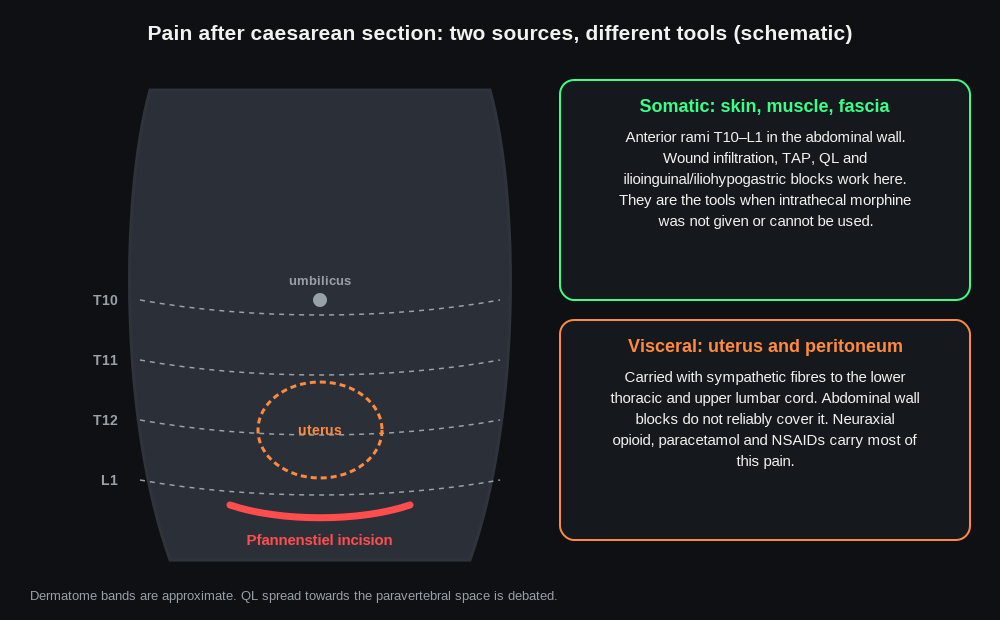
- Abdominal wall blocks treat the wound, not the uterus.
3Anatomy and physiology of pregnancy
Obstetric anatomy
- Pain pathways in labour. First stage pain (uterine contraction, cervical dilatation) travels with sympathetic fibres to T10–L1. Second stage pain (vagina, perineum) travels in the pudendal nerve to S2–S4. A labour epidural must cover both.
- Caesarean section needs a block to about T4–T6 for the peritoneum and uterine handling, with sacral cover.
- Abdominal wall. The Pfannenstiel incision lies in the T11–L1 dermatomes (ilioinguinal and iliohypogastric territory at its ends). The TAP, QL and ilioinguinal blocks reach these anterior rami.
- Lumbar spine. Lumbar lordosis increases and the interspinous spaces narrow. Tuffier's line (between the iliac crests) may lie higher than in non-pregnant women, so the interspace selected may be higher than intended: use ultrasound or choose a low space.
Physiological changes
| Change | Effect on regional anaesthesia |
|---|---|
| Engorged epidural veins (aortocaval compression) | Smaller epidural space; more cephalad spread; higher risk of vessel puncture and intravascular catheter |
| Increased nerve sensitivity to local anaesthetic (hormonal) | Lower doses give the same block height |
| Lower CSF volume in the lumbar region | Spinal spreads higher with the same dose |
| Aortocaval compression when supine | Hypotension after neuraxial block; use left lateral tilt or uterine displacement |
| Increased cardiac output, blood volume and heart rate | Faster absorption of local anaesthetic; dilutional anaemia |
| Lower plasma protein (albumin and alpha-1 acid glycoprotein) | More free local anaesthetic; respect the dose limits for fascial plane blocks |
| Hypercoagulable state; thromboprophylaxis is common | Timing of neuraxial procedures and catheter removal |
| Delayed gastric emptying in labour; airway oedema | General anaesthesia carries extra risk, which makes a working neuraxial block more valuable |
4Neuraxial anaesthesia and analgesia
Neuraxial techniques
Labour epidural
- Low-concentration local anaesthetic with an opioid (for example bupivacaine 0.1% or less with fentanyl), by programmed intermittent bolus and patient-controlled boluses, according to unit protocol.
- Test the catheter and check the block regularly. A block that is one-sided or patchy in labour will fail for caesarean section: replace it early.
- Combined spinal–epidural and dural puncture epidural give faster onset; local preference varies.
Spinal for caesarean section
- Hyperbaric bupivacaine 0.5% with an intrathecal opioid (morphine 50–100 µg or diamorphine 300 µg in UK practice) for post-operative analgesia.
- Phenylephrine infusion from the start to prevent hypotension; left uterine displacement.
- Check the block to touch (T5 or higher) before surgery, and document it.
Epidural top-up for caesarean section
- Use a rapid-onset solution (for example lidocaine 2% with adrenaline and bicarbonate, or levobupivacaine 0.5%) as per local protocol.
- Top up only a catheter that has worked well in labour.
- Be ready to convert to spinal or general anaesthesia if the block is not adequate.
Neuraxial ultrasound
Neuraxial ultrasound in pregnancy helps identify the level and the midline, and estimates the depth to the ligamentum flavum. It is most useful when landmarks are hard to feel (obesity, scoliosis, previous spinal surgery). A transverse interlaminar view shows the posterior complex (ligamentum flavum and dura) and the anterior complex; a paramedian sagittal oblique view shows the laminae and gaps. Practise with the lumbar spine scanner.
Abdominal wall after delivery: the muscles are stretched and thin, the rectus muscles may be separated (diastasis), and the wound and dressings limit probe placement. For TAP, scan in the mid-axillary line between the costal margin and the iliac crest. For QL, follow the TAP plane posteriorly to the quadratus lumborum.
 Illustration
Spinal anaesthesia: counting the lumbar levels up from the sacrum and the L5/S1 interspace to find the level. Spinal anaesthesia
 Illustration
Lumbar epidural: interlaminar view used to find the level and depth before a labour epidural. Lumbar epidural
Local anaesthetic requirements in pregnancy
Pregnancy lowers the dose needed for neuraxial block and raises the free fraction of local anaesthetic. For peripheral blocks, the main risk is the cumulative dose of bilateral fascial plane blocks and wound infiltration. Calculate the total dose in mg beforehand, using lean or booking weight rather than the term weight, and agree with the surgeon who gives what. Use the dose calculator.
Local anaesthetics cross the placenta. Fetal acidosis increases ion trapping, which is one reason to avoid large intravascular doses before delivery. Most drugs used after delivery pass into breast milk only in small amounts, but consult the unit pharmacist for anything unusual.
Equipment
- Neuraxial packs, 25–27 G pencil-point spinal needles, epidural kits with labelled, separate infusion lines.
- Curvilinear probe for neuraxial and QL scanning; linear probe for TAP and ilioinguinal.
- Vasopressor (phenylephrine) infusion and a bolus drug ready before the spinal.
- Equipment and drugs for general anaesthesia and the difficult obstetric airway.
- Lipid emulsion and the LAST protocol on the labour ward.
5Analgesia after caesarean delivery
Post-caesarean analgesia
PROSPECT (Roofthooft 2021) reviewed 145 trials of elective caesarean section under neuraxial anaesthesia and recommends:
- Before and during surgeryIntrathecal morphine 50–100 µg or diamorphine 300 µg with the spinal. Intravenous dexamethasone after delivery.
- After surgeryRegular paracetamol and NSAID; opioids for rescue only.
- If no intrathecal opioid (for example general anaesthesia)Single-shot wound infiltration, a continuous wound catheter, and/or a fascial plane block (TAP or QL).
- Surgical techniqueJoel-Cohen incision, no closure of the peritoneum, and abdominal binders also help.
PROSPECT does not recommend routine fascial plane blocks when intrathecal morphine has been given. A block may still help an individual woman with severe pain despite intrathecal morphine, or after a larger incision.
Peripheral nerve blocks
Peripheral blocks in obstetrics are mainly for the abdominal wall after caesarean section. Others are occasional:
- Pudendal nerve block by the obstetrician for instrumental delivery or perineal repair, when there is no epidural.
- Ilioinguinal/iliohypogastric blocks for the ends of a Pfannenstiel incision.
- Upper or lower limb blocks for injury or surgery during pregnancy, with the dose adjusted for pregnancy and the baby monitored as the obstetric team advises.
- Post-dural puncture headache: the greater occipital and sphenopalatine ganglion blocks have been tried; evidence is limited and an epidural blood patch remains the definitive treatment.
TAP and QL blocks
Both blocks treat the somatic pain of the wound. Use bilateral blocks, at the end of surgery or in recovery, with the total dose calculated for both sides.
| TAP block | QL block | |
|---|---|---|
| Plane | Between internal oblique and transversus abdominis | Around the quadratus lumborum (lateral, posterior or anterior approaches) |
| Cover | Anterior abdominal wall, T10–L1 | Abdominal wall; some spread towards the paravertebral space is described but debated |
| Position | Supine, easy after caesarean section | Lateral or supine with a wedge; deeper |
| Evidence after caesarean section | Useful without intrathecal morphine; inferior to it for pain at 6–12 hours (Hussain 2025) | Pain similar to intrathecal morphine, with less nausea (Hussain 2025, low certainty) |
| Main risks | LAST from bilateral volumes; liver or bowel injury (rare) | LAST; leg weakness from lumbar plexus spread (anterior approach) |
See the TAP, QL and transversalis fascia block pages.
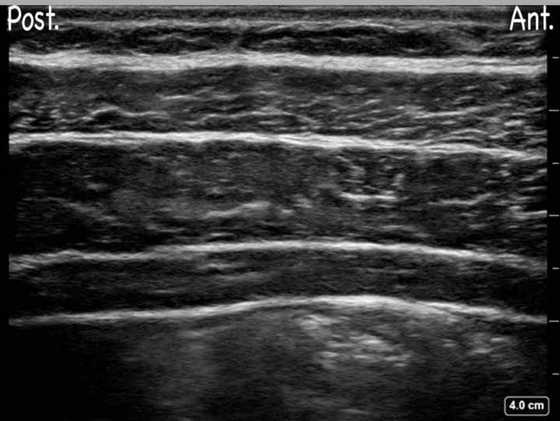 Ultrasound
 Illustration
TAP block: local anaesthetic between internal oblique and transversus abdominis. Transversus abdominis plane
 Ultrasound
 Illustration
QL block: the quadratus lumborum and the thoracolumbar fascia, posterior to the TAP plane. Quadratus lumborum blocks
These are non-pregnant scans with labelled illustrations.
6Contraindications, anticoagulation and low platelets
Contraindications
- Refusal; infection at the site; uncorrected hypovolaemia (haemorrhage) for neuraxial techniques.
- Coagulopathy and anticoagulants: see Anticoagulation below.
- Raised intracranial pressure; some cardiac lesions with fixed output (careful, graded epidural rather than single-shot spinal).
- Precautions for fascial plane blocks: the total local anaesthetic dose (bilateral blocks plus wound infiltration), low protein in pre-eclampsia, and magnesium therapy (which may add to weakness).
Anticoagulation
Check the current SOAP, national and local guidance for exact intervals. Never remove an epidural catheter without checking when the last anticoagulant dose was given.
Thromboprophylaxis with low molecular weight heparin is common before and after delivery. The SOAP consensus (Leffert 2018) gives pregnancy-specific advice and decision aids, weighing the risk of epidural haematoma against the risks of general anaesthesia.
The general principles are those of the anticoagulation module: wait the recommended interval after the last LMWH dose before a neuraxial procedure or catheter removal, and before the next dose after it. Plan the timing of thromboprophylaxis with the obstetric team before delivery, and write it in the notes.
Low platelets
Thrombocytopenia affects up to 12% of pregnancies. The SOAP interdisciplinary consensus (Bauer 2021) concluded that the risk of spinal epidural haematoma with a platelet count of 70 × 10⁹/L or more is likely to be very low in gestational thrombocytopenia, immune thrombocytopenia and hypertensive disorders of pregnancy, without other risk factors. Below that, decide case by case: consider the cause, the trend, other bleeding risks, and the risks of general anaesthesia.
In pre-eclampsia the count can fall quickly: check how recent the count is.
7Complications and troubleshooting
Complications
- Hypotension after spinal: prevent with phenylephrine infusion and uterine displacement.
- High or total spinal, especially after a spinal following a failed epidural, or an unrecognised intrathecal epidural catheter.
- Accidental dural puncture and post-dural puncture headache.
- Inadequate block for caesarean section: test before surgery; plan conversion.
- LAST from intravascular epidural injection or from bilateral fascial plane blocks. See the LAST module; lipid can be given in pregnancy, and perimortem caesarean delivery is part of resuscitation after about 20 weeks.
- Epidural haematoma or abscess: rare; check for new back pain, leg weakness or numbness after the expected duration of the block.
- Nerve injury: most postpartum nerve palsies are obstetric (from labour and positioning), not from the needle, but every one must be assessed.
Troubleshooting
- Patchy or one-sided labour epidural: pull back 1–2 cm, give a further dose in the lateral position, or re-site early.
- Block too low for caesarean section: top up (epidural), consider a spinal with a reduced dose (risk of a high block), or general anaesthesia; never let surgery start without an adequate block.
- Pain during caesarean section: listen to the woman. Offer more analgesia, and general anaesthesia if needed. Document the discussion.
- Severe wound pain despite intrathecal morphine: check for complications, then consider a rescue TAP or QL block within the dose allowance.
- Difficult neuraxial landmarks: ultrasound pre-scan to mark the midline and the level.
8Maternal safety
- Assess women with risk factors (obesity, difficult airway, cardiac disease, low platelets) early in pregnancy or in labour, and consider an early epidural.
- A working labour epidural is the best way to avoid an emergency general anaesthetic.
- Follow the women after neuraxial procedures until the block has worn off and they can walk; ask about headache and leg weakness.
- Give clear information about the risks of regional anaesthesia (the patient leaflets page includes national leaflets).
9Evidence and limitations
Neuraxial techniques are supported by decades of trials and national audits. Analgesia after caesarean section has strong evidence for intrathecal morphine; PROSPECT is based on 145 randomised trials.
For fascial plane blocks, Hussain 2025 pooled 18 trials (1525 women) comparing TAP, QL or ESP blocks with intrathecal morphine. Intrathecal morphine gave better pain scores than TAP at 6 and 12 hours. QL and ESP gave similar pain scores to intrathecal morphine, and TAP and QL caused less nausea and vomiting. The certainty of evidence was low.
Longer term, a Cochrane review update (Levene 2019) found that regional anaesthesia reduced the risk of persistent pain after caesarean section (odds ratio 0.46, moderate-quality evidence), although the trials were small.
Statistical versus clinical significance: a difference of about 1 cm on a 10 cm pain scale may not matter to an individual woman; nausea, itching and the ability to care for the baby may matter more.
10Clinical cases
WORKED CASECaesarean section under general anaesthesia
A woman has an emergency category 1 caesarean section under general anaesthesia. She weighs 85 kg at term (68 kg at booking). In recovery she has severe wound pain.
Discussion. No intrathecal opioid, so PROSPECT supports wound infiltration or a fascial plane block. Bilateral TAP or QL blocks with, for example, 20 mL of 0.25% levobupivacaine each side is 100 mg in total; check this against the maximum for her (using booking weight) and against anything the surgeon infiltrated. Give regular paracetamol and an NSAID if there is no contraindication.
11References
- Roofthooft E, Joshi GP, Rawal N, Van de Velde M; PROSPECT Working Group. PROSPECT guideline for elective caesarean section: updated systematic review and procedure-specific postoperative pain management recommendations. Anaesthesia 2021;76:665–680. PubMed 33370462
- Hussain N, Brull R, Thaete L, et al. The analgesic effects of novel fascial plane blocks compared with intrathecal morphine after Caesarean delivery: a systematic review and meta-analysis. Br J Anaesth 2025;134:1415–1431. PubMed 40074621
- Leffert L, Butwick A, Carvalho B, et al. The Society for Obstetric Anesthesia and Perinatology consensus statement on the anesthetic management of pregnant and postpartum women receiving thromboprophylaxis or higher dose anticoagulants. Anesth Analg 2018;126:928–944. PubMed 29099429
- Bauer ME, Arendt K, Beilin Y, et al. The Society for Obstetric Anesthesia and Perinatology interdisciplinary consensus statement on neuraxial procedures in obstetric patients with thrombocytopenia. Anesth Analg 2021;132:1531–1544. PubMed 33861047
- Levene JL, Weinstein EJ, Cohen MS, et al. Local anesthetics and regional anesthesia versus conventional analgesia for preventing persistent postoperative pain in adults and children: a Cochrane systematic review and meta-analysis update. J Clin Anesth 2019;55:116–127. PubMed 30640059
Every reference checked on PubMed (or at the publisher for guidance not indexed there) on 15 November 2026.