1Learning objectives
- Choose and perform appropriate blocks for rib fractures, hip fractures and limb injuries.
- Weigh the analgesic benefit of a block against the risk of delayed diagnosis of compartment syndrome, and plan monitoring.
- Apply anticoagulation guidance to injured patients, many of whom take anticoagulants or become coagulopathic.
- Adapt technique and dose in polytrauma and haemodynamic instability.
- Plan catheter techniques for prolonged analgesia.
2Overview
Injured patients are often in severe pain, frightened, and sometimes unstable. Regional anaesthesia can give fast, opioid-sparing analgesia that helps them breathe, cough, move and be examined, and it can be started in the emergency department. The best-established examples are the fascia iliaca or femoral block for a fractured neck of femur and chest wall techniques for rib fractures.
Trauma also brings particular risks: anticoagulants, coagulopathy, hypovolaemia, multiple injuries competing for one dose of local anaesthetic, and the worry about masking compartment syndrome. This module works through each injury group and these cross-cutting problems.
Clinical pearls
- A block is part of the trauma plan, not a substitute for the primary survey.
- Before any block, ask: is a neurological examination needed first, and has it been documented?
- In polytrauma, one total local anaesthetic budget covers every block, infiltration and catheter.
3Trauma analgesia and patient assessment
Trauma-related analgesia
Regional techniques are one part of trauma analgesia, which also includes splinting and reduction of fractures, paracetamol, carefully titrated opioids, ketamine, and NSAIDs where kidney function and bleeding allow.
- Severe pain from a single, well-defined injury (hip, femur, ribs, shoulder dislocation).
- Patients at risk from opioids: older and frail patients, obstructive sleep apnoea, chest injury.
- Analgesia for positioning (for a spinal, imaging or transfer).
- Prolonged analgesia with a catheter for multiple rib fractures or limb injuries.
Polytrauma
- Prioritise: life-threatening injuries first, then analgesia that helps breathing (chest) and transfer.
- Use one dose budget for all blocks, infiltration and catheters.
- Consider spinal injury before any neuraxial technique, and head injury before sedation.
- Coordinate with the trauma team so that blocks do not delay imaging or surgery.
- Record each block, its dose and time on the trauma chart so other teams can see it.
Haemodynamic instability
Neuraxial blocks cause sympathetic block and vasodilatation, which can be dangerous in hypovolaemia. Peripheral and fascial plane blocks have little haemodynamic effect and are preferred while the patient is being resuscitated. Acidosis, hypoxia and low cardiac output increase the toxicity of local anaesthetics, so reduce doses and monitor closely.
Anticoagulation
Many injured patients, especially older people with hip fractures, take anticoagulants or antiplatelet drugs, and trauma itself can cause coagulopathy. Superficial, compressible blocks (fascia iliaca, femoral, PENG, serratus anterior, many limb blocks) are often reasonable after a risk–benefit judgement; deep blocks (paravertebral, lumbar plexus) and neuraxial techniques follow neuraxial timing rules. See the anticoagulation module and the apixaban and ankle fracture case.
Contraindications
- Refusal, or inability to consent when the block is not urgent (head injury, intoxication): consider best-interest decisions and local policy.
- Need for neurological assessment that the block would mask (spinal injury, nerve injury with the fracture): examine and document first.
- Coagulopathy or anticoagulants for neuraxial and deep blocks.
- Haemodynamic instability for neuraxial techniques.
- High risk of compartment syndrome without an agreed monitoring plan.
- Infection or wounds at the site.
4Anatomy and ultrasound after injury
Anatomy
Trauma analgesia uses the same anatomy as elective surgery, but the injury decides the target. Key relationships:
- Chest wall: intercostal nerves T1–T12 run under each rib; the lateral cutaneous branch leaves at the mid-axillary line and the anterior cutaneous branch near the sternum. A block must reach the levels of every fractured rib, including posterior fractures near the spine.
- Hip: the anterior capsule is supplied by the femoral, obturator and accessory obturator nerves; the femoral and lateral femoral cutaneous nerves supply the anterior and lateral thigh skin.
- Femoral shaft: femoral nerve for the periosteum and quadriceps, with sciatic contribution posteriorly.
- Upper limb: the brachial plexus; the level of block follows the level of injury.
- Lower leg and ankle: sciatic (tibial and common peroneal) and saphenous nerves.
Sonoanatomy after injury
Injury changes the picture: haematoma, oedema, surgical emphysema and fracture fragments distort planes. Scan the uninjured side for comparison, and use colour Doppler to identify vessels in a haematoma. Patients may not be able to move into the usual position: choose blocks that work supine (fascia iliaca, PENG, serratus anterior, ESP in the lateral or sitting position if possible).
 Illustration
Suprainguinal fascia iliaca block: local anaesthetic under the fascia iliaca, above the inguinal ligament, for hip fracture. Suprainguinal fascia iliaca block
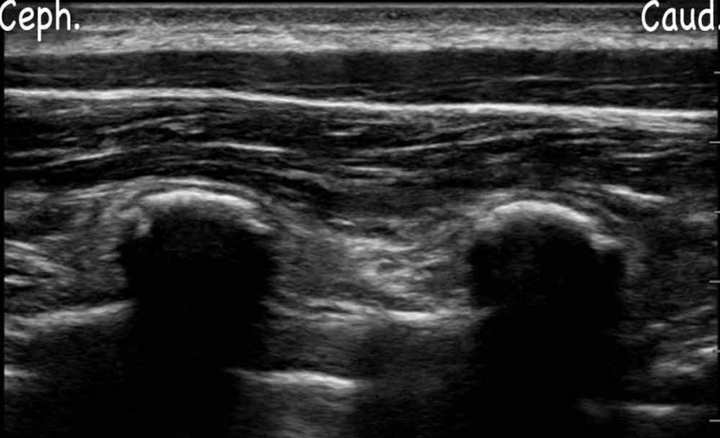 Ultrasound
 Illustration
Erector spinae plane block: transverse process, erector spinae and the injection plane, used for rib fractures. Erector spinae plane block
 Ultrasound
 Illustration
Serratus anterior plane block: lateral chest wall, for anterior and lateral rib fractures. Serratus anterior plane block
 Ultrasound
 Illustration
Femoral nerve block: lateral to the femoral artery, under fascia iliaca, for femoral shaft and hip fractures. Femoral nerve block
Scans are from elective patients, paired with labelled illustrations.
Equipment
- Portable ultrasound in the emergency department, with linear and curvilinear probes.
- Standard block needles and catheter kits; pumps for ward infusions.
- Monitoring (ECG, oxygen saturation, blood pressure) during and for 30 minutes after the block.
- Lipid emulsion and the LAST protocol in the emergency department as well as theatre.
- A documentation sheet that records the neurological examination before the block.
5Blocks by injury
Rib fractures
Pain from rib fractures stops the patient breathing deeply and coughing, which leads to atelectasis, pneumonia and respiratory failure, especially in older patients. Analgesia is one part of a bundle that also includes incentive spirometry, physiotherapy, and non-invasive ventilation where appropriate.
| Technique | Strengths | Cautions |
|---|---|---|
| Thoracic epidural | Most consistent evidence for pain and some outcomes | Anticoagulation, spinal injury, hypotension, needs a high-dependency setting |
| Thoracic paravertebral | One-sided, good analgesia, catheter possible | Deep, near pleura; anticoagulation rules as for deep blocks |
| Erector spinae plane | Easier, superficial, catheter possible; reduced pain and stay in trials | Spread varies; posterior fractures may need a separate level |
| Serratus anterior plane | Supine, simple; good for lateral and anterior fractures | Does not cover posterior fractures |
| Intercostal blocks | Precise for a few ribs | Many injections; pneumothorax; high absorption |
Use a scoring system or local pathway to decide who needs a regional technique (number of fractures, age, lung function, incentive spirometry volume). See the rib fracture case.
Fractured neck of femur
The Association of Anaesthetists 2020 guideline supports peripheral nerve blocks as part of standardised analgesia for hip fracture, from admission through surgery. A Cochrane review (Guay 2020, 49 trials) found that blocks:
- reduce pain on movement within 30 minutes (about 2.5 points on a 0–10 scale; high-certainty evidence);
- reduce acute confusional state (risk ratio 0.67; one fewer case for every 12 patients treated; high certainty);
- probably reduce chest infection and time to first mobilisation (moderate certainty);
- have uncertain effects on mortality and myocardial infarction (too few patients).
Options are the femoral, infrainguinal or suprainguinal fascia iliaca, and PENG blocks. A block given in the emergency department can be repeated or supplemented for surgery, within the total dose. See the hip fracture case.
Upper limb trauma
- Proximal humerus and shoulder dislocation: interscalene or superior trunk block; avoid in significant chest injury or poor lung function because of phrenic block.
- Humeral shaft and elbow: supraclavicular or infraclavicular.
- Forearm, wrist and hand: supraclavicular, infraclavicular or axillary; distal nerve blocks for single-nerve territories.
- Manipulation of wrist fractures in the emergency department: haematoma block or intravenous regional anaesthesia (Bier block) are alternatives where trained staff and equipment are available.
- Hand injuries and replantation: long-acting brachial plexus block or catheter for analgesia and sympathectomy.
Lower limb trauma
- Femoral shaft fracture: femoral or fascia iliaca block reduces muscle spasm and pain, and helps traction and transfer.
- Patella and knee: femoral or adductor canal with consideration of the posterior knee.
- Tibial fractures: highest risk of compartment syndrome; discuss any block with the surgeon (see below).
- Ankle and foot: popliteal sciatic with saphenous block; ankle block for forefoot.
- Amputation: sciatic and femoral catheters; may also reduce phantom and stump pain in the short term.
6Local anaesthetic dose and catheters
Cumulative dose
In multiple injuries, every block draws on one total dose. Write the total budget down, use dilute solutions where volume is needed, and consider catheters rather than repeated large single shots. Trauma patients may have low albumin, acidosis and hypovolaemia, all of which raise the risk of toxicity. Use the dose calculator, including the 'mix two drugs' option.
For limbs at risk of compartment syndrome, a dilute solution (for example 0.1–0.2% ropivacaine or 0.1–0.125% levobupivacaine) gives analgesia while keeping some sensation, so severe ischaemic pain can still break through.
Catheter techniques
Catheters extend analgesia for days: paravertebral, ESP or serratus catheters for rib fractures; femoral, fascia iliaca or sciatic catheters for limb injuries and amputations. They need a ward that can manage them, daily review and clear rules on anticoagulation and removal. See the continuous catheters module and the infusion programmer.
7Compartment syndrome
Compartment syndrome considerations
Acute compartment syndrome is a surgical emergency. The classic early sign is pain out of proportion to the injury, especially on passive stretch, so there is a long-standing worry that blocks might mask it. What the evidence shows:
- A critical review (Aguirre 2022) concluded that peripheral regional anaesthesia alone does not delay the diagnosis or treatment; epidural analgesia was linked to delay in 4 reported cases.
- A systematic review (Tran 2020) found only 6 case reports, 2 with delay, and could draw no firm conclusion.
- The ESRA/ASRA paediatric advisory found no evidence that regional anaesthesia increases the risk or delays the diagnosis in children (Ivani 2015).
- Identify high-risk injuries (tibial shaft, forearm fractures, crush injuries, long surgery with a tourniquet) and discuss with the surgeon before the block.
- Use dilute solutions and avoid dense motor block; avoid adjuvants that greatly prolong the block in high-risk limbs.
- Agree who monitors the limb, how often, and whether compartment pressure monitoring is used.
- Treat breakthrough pain in a blocked limb as a warning sign, not just as a block failure: examine the limb.
- Document the discussion and the plan.
8Complications and troubleshooting
Complications
- LAST from cumulative doses: see the LAST module.
- Haematoma in anticoagulated or coagulopathic patients.
- Pneumothorax with chest wall blocks, which may be hard to tell from the injury itself; re-check imaging if breathing worsens.
- Falls from a numb or weak leg (hip fracture patients mobilising).
- Masked compartment syndrome or nerve injury if monitoring is not in place.
Troubleshooting
- Patient cannot lie in the block position: choose a block that works supine, give analgesia first (for example ketamine), or position with help.
- Distorted anatomy: scan the other side, use colour Doppler, and go slower.
- Rib fracture block not covering all levels: add a second ESP level or a catheter; serratus will not reach posterior fractures.
9Evidence and limitations
Hip fracture: high-certainty evidence for pain relief and fewer cases of acute confusion (Guay 2020). Effects on mortality are uncertain.
Rib fractures: a network meta-analysis of 27 trials (Gamberini 2024) found that thoracic epidural consistently reduced pain at 24 hours, ventilation time and ICU and hospital stay, and ESP reduced pain and hospital stay, with low to moderate confidence. The EAST/CWIS guideline for older adults (Mukherjee 2022) made no recommendation for or against epidural or other regional analgesia, because effects on pneumonia, ventilation and mortality were not shown.
Compartment syndrome: evidence is case reports and reviews of them; it cannot prove safety or harm.
Statistical versus clinical significance: lower pain scores matter most when they translate into better breathing, earlier mobilisation and less delirium.
10Clinical cases
WORKED CASERib fractures and a femoral shaft fracture
A 70 kg man after a motorbike crash has right ribs 4–8 fractured (two posteriorly) and a right femoral shaft fracture. He is stable after resuscitation. His platelets and clotting are normal.
Discussion. Plan one dose budget. A right ESP catheter at about T6 can cover the rib fractures, including the posterior ones; a femoral or fascia iliaca block treats the femur. For example, 20 mL of 0.25% levobupivacaine for the ESP (50 mg) and 20 mL of 0.25% for the fascia iliaca (50 mg) total 100 mg, within the limit for 70 kg; then a dilute infusion through the ESP catheter. Discuss compartment syndrome risk for the thigh with the orthopaedic team.
11References
- Griffiths R, Babu S, Dixon P, et al. Guideline for the management of hip fractures 2020: guideline by the Association of Anaesthetists. Anaesthesia 2021;76:225–237. PubMed 33289066
- Guay J, Kopp S. Peripheral nerve blocks for hip fractures in adults. Cochrane Database Syst Rev 2020;11:CD001159. PubMed 33238043
- Gamberini L, Moro F, Dallari C, et al. Regional anesthesia modalities in blunt thoracic trauma: a systematic review and Bayesian network meta-analysis. Am J Emerg Med 2025;89:199–208. PubMed 39740311
- Mukherjee K, Schubl SD, Tominaga G, et al. Non-surgical management and analgesia strategies for older adults with multiple rib fractures: a systematic review, meta-analysis, and joint practice management guideline from the Eastern Association for the Surgery of Trauma and the Chest Wall Injury Society. J Trauma Acute Care Surg 2023;94:398–407. PubMed 36730672
- Aguirre JA, Wolmarans M, Borgeat A. Acute extremity compartment syndrome and (regional) anesthesia: the monster under the bed. Anesthesiol Clin 2022;40:491–509. PubMed 36049877
- Tran AA, Lee D, Fassihi SC, et al. A systematic review of the effect of regional anesthesia on diagnosis and management of acute compartment syndrome in long bone fractures. Eur J Trauma Emerg Surg 2020;46:1281–1290. PubMed 32072224
- Ivani G, Suresh S, Ecoffey C, et al. The European Society of Regional Anaesthesia and Pain Therapy and the American Society of Regional Anesthesia and Pain Medicine joint committee practice advisory on controversial topics in pediatric regional anesthesia. Reg Anesth Pain Med 2015;40:526–532. PubMed 26192549
Every reference checked on PubMed (or at the publisher for guidance not indexed there) on 15 November 2026.