1Learning objectives
- Choose an evidence-based regional technique for shoulder, hip, knee, foot and ankle, and hip fracture surgery.
- Balance analgesia against motor block, falls risk and early mobilisation.
- Plan for rebound pain when single-shot blocks wear off.
- Decide between a catheter, a single shot and local infiltration analgesia.
2Overview
Orthopaedic surgery is where regional anaesthesia is used most, and where its goals have changed most. The aim is no longer the densest, longest block, but good analgesia that lets the patient stand, walk and go home early, without falls and without a night of rebound pain.
PROSPECT recommendations now exist for most major orthopaedic operations. They start with a basic analgesic bundle (paracetamol, an NSAID and IV dexamethasone unless contraindicated) and then add one regional technique chosen for that operation.
Clinical pearls
- Basic analgesia first: paracetamol, NSAID, dexamethasone.
- Choose the block that the operation needs, not the one with the longest motor block.
- Plan the first 48 hours, not just the first 12: rebound pain is predictable.
3Anatomy and sonoanatomy
Anatomy
| Joint | Main sensory supply | Motor nerves to protect |
|---|---|---|
| Shoulder | Suprascapular (most of the joint), axillary, lateral pectoral; skin from supraclavicular nerves | Phrenic nerve (diaphragm) |
| Hip | Femoral, obturator and accessory obturator articular branches (anterior capsule); sciatic and nerve to quadratus femoris (posterior) | Femoral (quadriceps) |
| Knee | Saphenous and genicular branches (anterior), obturator, popliteal plexus from tibial and obturator (posterior) | Femoral (quadriceps), common peroneal (foot drop) |
| Foot and ankle | Tibial, deep and superficial peroneal, sural, saphenous | Sciatic branches (whole-leg weakness with popliteal block) |
Sonoanatomy
Each operation has a small set of blocks to master: interscalene and superior trunk for the shoulder; PENG and suprainguinal fascia iliaca for the hip; adductor canal, IPACK and genicular for the knee; popliteal sciatic and ankle blocks for the foot. Use the scan explorer to practise the sonoanatomy of each.
 Ultrasound
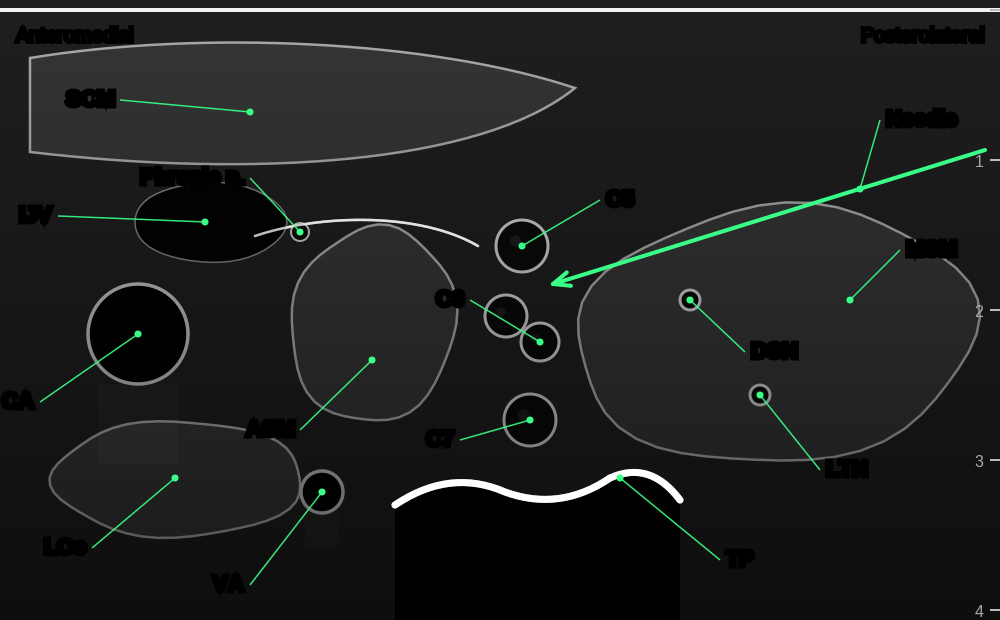 Illustration
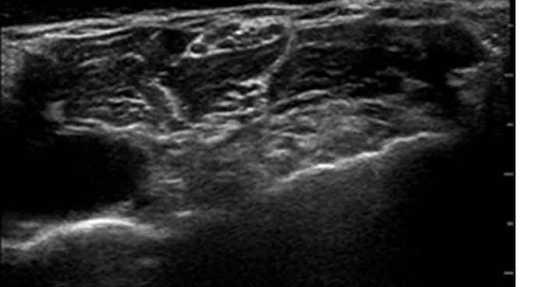
Interscalene: roots of C5–C6 between the scalene muscles; the standard block for shoulder surgery. Interscalene block
 Ultrasound
 Illustration
Superior trunk: a slightly more distal target that may spare the diaphragm more often. Superior trunk block
 Ultrasound
 Illustration
PENG: articular branches to the anterior hip capsule, sparing the quadriceps. PENG block
 Ultrasound
 Illustration
Adductor canal: saphenous nerve and the nerve to vastus medialis beside the femoral artery under sartorius. Adductor canal block
4Patient selection
Indications
- Every major joint operation unless the patient declines or there is a contraindication.
- Patients at high risk from opioids: obstructive sleep apnoea, frailty, chronic lung disease.
- Day-case and short-stay joint replacement programmes, where analgesia must allow walking the same day.
- Hip fracture from the moment of diagnosis.
Contraindications
- Patient refusal; infection at the site.
- Anticoagulation for deep blocks and neuraxial techniques: see the anticoagulation module.
- Severe respiratory disease for interscalene block.
- Pre-existing nerve damage in the operative limb: document it and discuss (see the neurological disease module).
- Surgeon's need for an early postoperative nerve examination (for example some spinal and complex revision surgery).
5Operation by operation
Shoulder surgery
- Rotator cuff repair: interscalene block, or suprascapular block with or without an axillary nerve block (Toma 2019).
- Total shoulder arthroplasty: single-shot interscalene block with plain long-acting local anaesthetic; local infiltration if a block is not possible (Mrazek 2026).
- Diaphragm: interscalene block paralyses the hemidiaphragm in most patients at standard volumes; lower volumes, the superior trunk and suprascapular approaches reduce but do not remove the risk (El-Boghdadly 2017). See the shoulder and COPD case.
Hip arthroplasty
- Basic analgesia plus a single IV dose of dexamethasone (up to 10 mg); low-dose intrathecal morphine (0.1 mg) may be considered with spinal anaesthesia in inpatients (Carella 2026).
- Preferred blocks: suprainguinal fascia iliaca or preoperative PENG; local infiltration as the alternative.
- Quadratus lumborum and lumbar ESP blocks are not recommended for hip arthroplasty: inconsistent benefit and more weakness.
Knee arthroplasty
- Adductor canal block with local infiltration analgesia and IV dexamethasone (Lavand'homme 2022).
- Adductor canal block gives similar analgesia to femoral block with better quadriceps strength (Jaeger 2013; Kim 2014).
- IPACK or genicular blocks can add posterior and capsular analgesia; their extra benefit on top of local infiltration varies. See the painful knee replacement case and the failed adductor canal case.
Hip fracture
Block early, in the emergency department where possible, with fascia iliaca, femoral or PENG: this reduces pain and acute confusion (Guay 2020; Griffiths 2021). Spinal and general anaesthesia gave similar outcomes in REGAIN (Neuman 2021). See the trauma module and the frail patients module.
Foot and ankle surgery
- Hallux valgus: ankle block first choice, wound infiltration as an alternative (Wust 2026).
- Hindfoot and ankle fixation: popliteal sciatic with saphenous (or adductor canal) block; consider a catheter for major reconstruction.
- Calf tourniquet is usually tolerated with an ankle or popliteal block; a thigh tourniquet needs spinal or general anaesthesia.
Spine surgery
Paraspinal fascial plane blocks (erector spinae, thoracolumbar interfascial) and intrathecal morphine are used for lumbar spine surgery. Evidence is growing but heterogeneous; check the surgeon's preference about wound infiltration and early neurological examination. Block after positioning and before incision, or ask the surgeon to infiltrate under direct vision.
Motor-sparing blocks and early mobilisation
| Instead of | Consider | Why |
|---|---|---|
| Femoral block (knee) | Adductor canal block | Better quadriceps strength (Jaeger 2013; Kim 2014) |
| Lumbar plexus block (hip) | PENG or suprainguinal fascia iliaca | Easier, superficial, recommended by PROSPECT (Carella 2026) |
| Interscalene (shoulder, poor lungs) | Superior trunk or suprascapular with axillary | Less diaphragm impact (El-Boghdadly 2017) |
| Popliteal sciatic (forefoot) | Ankle block | Patient can walk with a heel-weight-bearing shoe |
6Dose and equipment
Local anaesthetic dose
Combined blocks and surgeon infiltration share one dose budget: agree volumes and concentrations with the surgeon before the case. For example, local infiltration analgesia for a knee replacement often uses a large volume. Use the dose calculator, including the option to mix two drugs. IV dexamethasone prolongs blocks and reduces rebound pain (Singh 2026).
Equipment
- Linear probe for most limb blocks; curvilinear for PENG, suprainguinal fascia iliaca in larger patients, and subgluteal sciatic.
- A block room or induction area so blocks do not delay the list.
- Catheter kits and pumps for major foot and ankle reconstruction and revision surgery.
7Complications and troubleshooting
Complications
- Falls from quadriceps weakness after femoral, fascia iliaca or high-volume PENG blocks, and after femoral catheters (Ilfeld 2010).
- Hemidiaphragmatic paresis after interscalene block.
- Nerve injury, often multifactorial (surgery, tourniquet, positioning).
- LAST when blocks and local infiltration are combined without a dose plan.
Falls and rebound pain
- Assess quadriceps strength before the first walk; use a knee brace and supervision if weak.
- Rebound pain usually starts the first night as the block wears off. Plan regular oral analgesia before it does, with clear instructions (Yin 2025).
- Give IV dexamethasone where suitable (Singh 2026).
- Tell day-case patients what to expect and when to take their tablets.
Troubleshooting
- Pain behind the knee after adductor canal block: consider IPACK or a supplementary infiltration.
- Shoulder pain despite interscalene block: check for a missed skin territory (supraclavicular nerves) or block failure; see the failed blocks module.
8Catheters or local infiltration
PROSPECT now favours single-shot techniques with good systemic analgesia for most primary joint replacements. Catheters (interscalene, adductor canal, popliteal) are useful for major reconstructions, revision surgery and patients with chronic pain, but they add workload and risk. Local infiltration analgesia is the recommended alternative when a block is not possible for hip, knee and shoulder replacement. See the continuous catheters module.
9Evidence and limitations
Procedure-specific guidelines (PROSPECT) synthesise many randomised trials for each operation. Motor-sparing blocks have strong evidence for preserved strength (Jaeger 2013; Kim 2014) and for hip analgesia (Lin 2021). Effects on longer-term outcomes (function at 3 months, chronic pain) are less clear. Hip fracture blocks have high-certainty evidence for pain and delirium (Guay 2020).
10Clinical cases
- CLINICAL CHALLENGEHip fracture in a frail patient on apixaban
- CLINICAL CHALLENGEShoulder surgery and severe COPD
- CLINICAL CHALLENGESevere pain after total knee replacement
- CLINICAL CHALLENGEPain after knee replacement despite an adductor canal block
- CLINICAL CHALLENGEChoosing regional techniques for ambulatory surgery
- CLINICAL CHALLENGEApixaban and an ankle fracture
WORKED CASESame-day knee replacement
A fit 62-year-old is listed for a day-case knee replacement under spinal anaesthesia.
Discussion. Short-acting spinal; adductor canal block with surgeon-administered local infiltration analgesia; paracetamol, an NSAID and IV dexamethasone. Check quadriceps strength before the first walk. Send home with regular oral analgesia started before the block wears off and a phone number for the night.
11References
- Toma O, Persoons B, Pogatzki-Zahn E, et al. PROSPECT guideline for rotator cuff repair surgery: systematic review and procedure-specific postoperative pain management recommendations. Anaesthesia 2019;74:1320–1331. PubMed 31392721
- Mrazek I, Desai N, Sauter AR, et al. Pain management after total shoulder arthroplasty: a systematic review and procedure-specific postoperative pain management (PROSPECT) recommendations. Anaesthesia 2026 (online ahead of print). PubMed 42910655
- Carella M, Bugada D, Van de Velde M, et al. PROSPECT guideline for total hip arthroplasty: updated systematic review and procedure-specific postoperative pain management recommendations. Anaesthesia 2026 (online ahead of print). PubMed 42473710
- Lavand'homme PM, Kehlet H, Rawal N, et al. Pain management after total knee arthroplasty: PROcedure SPEcific Postoperative Pain ManagemenT recommendations. Eur J Anaesthesiol 2022;39:743–757. PubMed 35852550
- Wust M, Desai N, Joshi GP, et al. Pain management after hallux valgus repair surgery: an updated systematic review and procedure-specific postoperative pain management (PROSPECT) recommendations. Eur J Anaesthesiol 2026;43:11–18. PubMed 41122054
- Griffiths R, Babu S, Dixon P, et al. Guideline for the management of hip fractures 2020: guideline by the Association of Anaesthetists. Anaesthesia 2021;76:225–237. PubMed 33289066
- Guay J, Kopp S. Peripheral nerve blocks for hip fractures in adults. Cochrane Database Syst Rev 2020;11:CD001159. PubMed 33238043
- Neuman MD, Feng R, Carson JL, et al. Spinal anesthesia or general anesthesia for hip surgery in older adults. N Engl J Med 2021;385:2025–2035. PubMed 34623788
- Jaeger P, Nielsen ZJ, Henningsen MH, et al. Adductor canal block versus femoral nerve block and quadriceps strength: a randomized, double-blind, placebo-controlled, crossover study in healthy volunteers. Anesthesiology 2013;118:409–415. PubMed 23241723
- Kim DH, Lin Y, Goytizolo EA, et al. Adductor canal block versus femoral nerve block for total knee arthroplasty: a prospective, randomized, controlled trial. Anesthesiology 2014;120:540–550. PubMed 24401769
- Lin DY, Morrison C, Brown B, et al. Pericapsular nerve group (PENG) block provides improved short-term analgesia compared with the femoral nerve block in hip fracture surgery: a single-center double-blinded randomized comparative trial. Reg Anesth Pain Med 2021;46:398–403. PubMed 33637625
- El-Boghdadly K, Chin KJ, Chan VWS. Phrenic nerve palsy and regional anesthesia for shoulder surgery: anatomical, physiologic, and clinical considerations. Anesthesiology 2017;127:173–191. PubMed 28514241
- Ilfeld BM, Duke KB, Donohue MC. The association between lower extremity continuous peripheral nerve blocks and patient falls after knee and hip arthroplasty. Anesth Analg 2010;111:1552–1554. PubMed 20889937
- Yin W, Luo D, Mi H, et al. Rebound pain after peripheral nerve block: a review. Drugs 2025;85:991–1002. PubMed 40402360
- Singh NP, Makkar JK, Zhang C, et al. Prophylactic interventions to prevent rebound pain after peripheral nerve block in adults: a systematic review and network meta-analysis of randomised controlled trials. Anaesthesia 2026;81:1281–1292. PubMed 42187168
Every reference checked on PubMed (or at the publisher for guidance not indexed there) on 15 November 2026.